Showing posts with label autism. Show all posts

Wednesday, November 30, 2016

Print Festival Report Critique

Critique of my report,
 by my Print Making class professor Aragon

Great description of the pieces; your narrative of the essay has a natural flow but there are times when it felt a bit dry. Mainly because there were some sentences that need to be connected rather that have them on their own. When you create short sentences you define a style that mimics a more factual element of the piece; in your case, while you are using facts, I think it would’ve helped the tone of voice of the paper to be less formal so that the reader can “immerse” into the description of the events or the artworks. It seems to me you really enjoyed the Print Fair and had quite the time discovering new artists and their work. I hope this has translated into your own ideas for future pieces and makes you push yourself into creating more complicated imagery.


Keep up the good work

Sunday, November 20, 2016

Met Art Museum Report

Met Art Museum Report

November 20, 2016

Rewritten December 2, 2016

These are Claude Monet’s pieces, Four Trees and Manneporte (Etretat). The Manneport surprises me because there are a lot more details than you expect from the father of Impressionism. Still, there’s a lot of shadow and motion, from the curve of the rock and the movement of the water, which you expect from Impressionism. It had a lot more detail than the Four Trees. Manneport has a lot of feeling, such as my Mask piece. My Mask piece gives you a feeling of horror. Manneport gives you a feeling of loneliness, like a leaving. I liked the fact thatthe inside of the arch in Manneport was very bright on the yellow/orange side, which contrasted with the dark blue water and light blue sky. Four Trees has very little contrast. Just a bit of yellow sky. There was also a lot of hard edges in the arch, unlike Four Trees, which has very few hard edges. It helped Manneport in that it was very close, allowing for a lot of the detail that made it so good. Four Trees is more distant and has less detail and, being an Impressionist piece, suggests a lot, like my Doll House.


I also saw Vincent Van Gogh’s Wheat Field With Cypresses. I was impressed with the way he used color, mostly blue skies and very green plants, contrasted with the very yellow wheat field. His contrasts and composition were effective like Manneport, though it was much more distant, like Four Trees.  He used a lot of bright color, the way I did with my Fruit On The Table piece, but he was a lot more organized with his complimentary colors and composition. Van Gogh's yellow in Wheat Field contrasted the blue and the green the way the yellow/orange contrasted against the blue in Manneport. Even the blue and green were interesting in the way they were separated, though they're not contrasting colors, they were contrasted in their shape. the green plants have a lot of short lines, while the sky has a lot of broad, blue space. Another point of contrast in Wheat Fields is that it is mostly vertical, except for the tree on the right going upward, not centered, giving us a surprise. Four Trees has four, evenly space trees that don't contrast with the rest of the picture.


Finally, there was Siesta, by Paul Gauguin. Frankly, I wasn’t impressed. It was a very peaceful piece, no where near as erotic as we’ve come to expect from him. I saw little else that impressed me. There was bright and dark colors in some of the shirts, which contrasted with the green glass, but it wasn't as impressive as Monet's and Van Gogh's color, contrast and composition. No really hard or soft edges. No emphasis on any space. It's just a painting of a family photo.


Friday, November 11, 2016

Print Festival Report

Print Festival Report
by David Rubin


Today I went to see Print Festival, at the International Print Center, at 524 W 26 St, Manhattan. It was an exhibit of print art by students.
There was so many good-looking prints, I didn’t know where to look first. I was also surprised at how simple some of the work was. Some of it was as simple as making a print of pressed dandelions and it looked great.
My favorite artist is Lizzy Itzkowitz, a cartoon art student at the School of Visual Arts. She’s been working at it for seven years, studying the Adobe Creative Suite. She’s worked on a variety of media, including gouache, acrylic, paper collage and digital. She does a lot of print pictures, as well as cartoon booklets. You can see her work at https://www.behance.net/lizzyitz
She screen printed a lot of designs and I love all the color, especially the cat. The
cat has three colors, neon pink, neon yellow and neon blue. All those blotches of neon curvy color make it seem quite happy, especially the large orange on yellow on his belly, which strikes me as much of a greeting as the raised left arm.
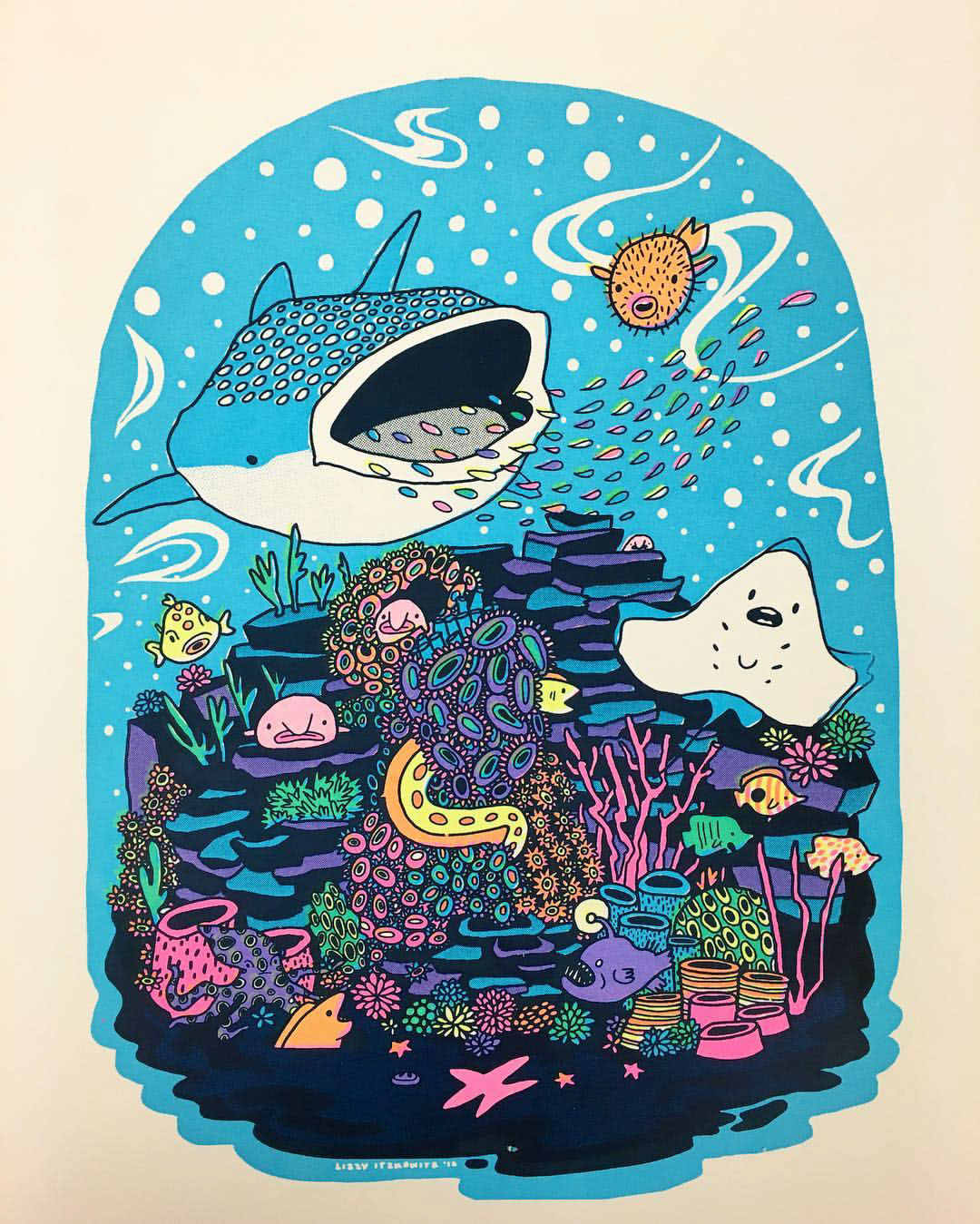
She also screen printed Cactus Terrarium, 11"X17", neon pink, neon yellow, neon blue and navy blue, and Coral Reef, same size and colors, done on a transparency, below. Like the cat, they are both beautiful because of all the bright, neon colors.
I like the looks of Coral Reef. There seems to be a lot of movement in that sky blue background.
As for Cactus Terrarium, as good as it looks, it looks out place without any background. I’d have printed  it as being on a table, or something. It is on a transparency. Perhaps the background is whatever she puts it on. If it were me, I’d have painted a table and put the transparency on it, a multimedia.
Another piece I liked, to the right, is Monday’s 2016, by Kathleen Johnson. It’s a 28" X 29" woodcut. Clearly this belongs on the cover of Fantasy & Science Fiction magazine. It’s nothing but black lines on a white sheet. Allthose lines give it a lot of horrific detail, especially the thin lines on his face and nose. All that horror is emphasized by the thin black rays around it.

Monday, September 12, 2016

Autistic College Experience

I’m an 59 year old autistic person and, most of my life, had little ability to gain or hold down a job, even with the English degree I got from this institution,  so what did I do when my mother died and I came into some money? I came back to this institution!
Over the past few years, I’ve gotten to be something of an amateur artist. You can see my art blog at www.daru3-davidart.blogspot.com , so an art major was a natural. Also, the first time I was at CSI, I majored in computer science, but did poorly in the advanced classes before switching to an English major, so I’m trying a computer major again now.
I started the summer of 2015, with Intro to Computer Programming and, despite some problems with the last lessons, I got a B, so I went ahead with Fall classes. I registered for Intermediate Computer Programming, but couldn’t understand the teacher. She had a rather thick Russian accent, or at least I thought so. My class mates understood, but, being autistic, I need a certain amount of precision, so, to me, this Russian woman sounded like she had big plans for moose & squirrel.  I dropped her in favor of Intro to Portraits, which immediately followed Intro to Drawing, giving me eight consecutive hours of drawing models, nude and dressed. It was too much consecutive time. I missed much and only got B’s.
I also got a B for Intro to Painting class. It was hard in that, though I am an artist, my teacher, Geoffrey Dorfman, had to tell me to slow down and concentrate on my details, even while telling me to get done in the few weeks we have.
In the spring, I took Intermediate Programming for a second time and again, had to drop it, for want of an understandable teacher.
I also took Art 100 and had Mieke Paulsen, a wonderful lecturer. I loved listening to her. Just one thing. She just talked, wrote little or nothing on the board, so I wrote little or nothing, leaving me with no notes. I was so sorry to drop her course.
This left me with one course, Intro to Sculpture, which was a truly fun class, an easy A.
This year, I’m taking Intermediate Painting and, for a third time, Intermediate Computer Programming. I tried taking Intermediate Drawing, but my teacher, Professor Pels, couldn’t even handle normal students. She had no idea how to handle an autistic student and wouldn’t learn how. With the Art Chairman’s help, I switched to printing.


Monday, October 21, 2013

Autism on the Rise


It used to be really rare, then it became as common as one in eighty-eight. People have theorized why it's growing. I have my own theory.
First, let me explain what autism is. Autism, for those of you who don't know, is a form of developmental disability, characterized by an inability to deal with other human beings. It's usually associated with intellectual limitations, but there's a subset of autistics that often have superior intelligence. We are called Aspies, short for Asperger syndrome. We have our limitations, but many of us think it's worth it and value our condition. We object to those of you NT's (neuro-typicals) who want to cure us. I, myself, wear a shirt saying my autism make me smarter than you. We also can be rather obsessive over our particular interests. Nobody sweats the details like us, even if it's just a bus schedule.
 A decade ago Thorkil Sonne, a telecommunications executive living in Ringsted, Denmark, as terrified about what the future might hold for his 7-year-old autistic son, Lars. But rather than give in to despair, the middle-aged father started a company, Specialisterne (ASpecialists@ in Danish), which helps high-functioning adults with autistic-spectrum disorders (ASDs) find employment. Today business is booming. Sonne oversees branches in a fourteen countries, including Germany, England, and Spain, and is funneling workers to such IT giants as SAP. Now he has even moved to Delaware to establish a foothold in America.
We object to those of you NT's (neuro-typicals) who want to cure us. I, myself, wear a shirt saying my autism make me smarter than you. We also can be rather obsessive over our particular interests. My theory? I think it's nature taking its course. It's evolution in action! The latest research says we seem to be caused by two mutations. There are certain companies that have taken advantage of our superior abilities and will only hire those of us with our special mutations,
My theory? I think it's nature taking its course. It's evolution in action! The latest research says we seem to be caused by two mutations. There are certain companies, such as my own, that have taken advantage of our superior abilities and will only hire those of us with our special mutations.
Continuing in this vein, I figure it's just a matter of time before the government tries to register and weaponize us and tries to control us. Resisters will be chased by giant robots and men in black.
I think I read too many comic books. That's my autistic obsession.


Tuesday, January 31, 2012

Possibili-Tees

People see developmentally disabled and autistic kids and think it’s so wonderful there are so many treatments and so many “special” schools for kids like us, but once we grow up, what do you do with us? Thank G-d, we don’t get warehoused anymore. Sheltered workshops work for some, but some of us are too bright to be adding parts, assembling the latest gadgets. You’ve seen Criminal Minds? Can you picture how bored to death Spencer Reid would be? Unfortunately, we can’t all work for the FBI and not all of us Asperger autistics are geniuses, any more than we’re all so limited in intellect.

If you’re really interested, my IQ has been measured at 126, fourteen points below genius, though twenty-six points above average!

We can’t all be mainstreamed either. Many of us don’t have the interpersonal skills to be a doctor or a lawyer. I tried working as a substitute teacher. It was a horror. I had no idea how to behave as a teacher or any other kind of authority figure. My license was lifted after two years.

I spent several years as a messenger. I could certainly do the job, but I felt very over-qualified, especially considering my coworkers were an ex-con, a person with intellectual limitations, and a new immigrant who could barely speak English. Good enough for a college student, but not good enough for a grad.

I spent almost thirteen years in an earlier screen printing shop, doing nothing more than cleaning squeegees and reclaiming screens after a job. It was the kind of over-simple but tedious work best suited to my intellectually limited coworker. He once told me how he wished he was smart like me. I pointed out that, despite my intelligence and education, I was still there working right next to him doing the same work. I hoped it made him feel better, because it depressed me!

Fortunately for me, Thomas Siniscalchi understood our needs, so he started Possibili-Tees, a custom screen printing nonprofit business, made to hire people like me.

Tom and I met fifteen years earlier when he started the screen print shop I worked for earlier, for the mentally disabled. I worked there because developmental disabilities often carry with them mental disorders, such as chronic depression, which I keep under control with drugs and counseling.

Two years ago, he became frustrated with the way I and other employees were treated, so he left there to start Possibili-Tees and invited me to join him here.

Possibili-Tees is different from a sheltered workshop in that it is not a program. It assumes we employees are employees and treats us like it. In other situations, there are special counselors, trained to look over the shoulders of “mental health service consumers”, (“consumers”, for short). In the first year of Tom’s earlier shop, we were required to interrupt the day for group counseling. Tom stopped this and fired the counselor. One of our first firings in that shop was because the man went outside to beg for butts and change. Tom said that that’s consumer behavior, not employee behavior. As employees, we have to pay attention to normal, employment requirements, like grooming, attendance, quality control and attention to task, yet it still works to serve our special needs, such as allowing, even demanding, that we take the time to see psychiatrists and psychotherapists as needed.

I’ve been working here ever since, two days a week, using the internet to find possible customers and philanthropic donors.

Autism On The Rise

Autism is on the rise. It used to be really rare, then it became as common as one in eighty-eight. People have theorized why it's growing. I have my own theory.

First, let me explain what autism is. Autism, for those of you who don't know, is a form of developmental disability, characterized by an inability to deal with other human beings. It's usually associated with intellectual limitations, but there's a subset of autistics that often have superior intelligence. We are called Aspies, short for Asperger syndrome. We have our limitations, but many of us think it's worth it and value our condition. We object to those of you NT's (neuro-typicals) who want to cure us. I, myself, wear a shirt saying my autism make me smarter than you. We also can be rather obsessive over our paticular interests. Nobody sweats the details like us, even if it's just a bus schedule.

My theory? I think it's nature taking its course. It's evolution in action! The latest research says we seem to be caused by two mutations.There are certain companies, such as my own, that have taken advantage of our superior abilities and will only hire those of us with our special mutations.

Continuing in this vein, I figure it's just a matter of time before the government tries to register and weaponize us and tries to control us. Resisters will be chased by giant robots and men in black.

I think I read too many comic books. That's my autistic obsession.

David Rubin